
 Welcome to Torrey Pines Gulls
Al Doig – Modeler of the Year - 1977
Al Doig (AMA 20888) started life in Seattle but was so smart at a young age that he convinced his parents to move to San Diego at the age of four. After receiving primary education at San Diego area schools, he went to UC Los Angeles and earned a degree in electronics. During that time in the 1950s, he also became very interested in radio-controlled modeling. With his electronics background it didn’t take long for Doig to consider applications of what he had learned towards RC. He designed a new system for proportional radio, calling it the ultimate in multiplex radio or “ULTI Multi” for short. This was in the late 1950s and it wasn’t until 1959 that Doig published the design in American Modeler magazine1,2. The ULTI Multi was never fully refined or manufactured commercially.
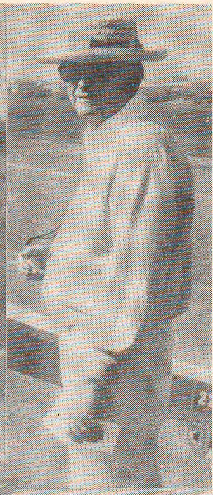
In the August 1976 issue of the TPG newsletter, Ken Banks wrote a nice description of Doig’s ULTI system for the layman. At the time Doig developed the system, most multi-control R/C aircraft used reed systems. The transmitter broadcasted a continuous carrier, and various audio tones were superimposed on it to actuate a control. For instance, one tone controlled up elevator, and another commanded down elevator. In the absence of either tone, the elevator would go to neutral. Any "proportional" control of the elevator was the result of a pulsed signal to provide “intermediate” amounts of deflection. The limited proportional systems of the time relied on pulse rate or width encoding and mechanical decoding through a pulsed servo (as in the case of the more-famous Galloping Ghost control system.)
Doig’s ULTI multi used a variable frequency tone that was controlled by the transmitter stick position. One audio band was used for each control. In the receiver a pair of fixed frequency filters located at either end of the band were used to provide an output voltage that was dependent on the position of the stick. This voltage controlled the position of the servo arm through a feedback system which used a potentiometer to sense the output arm position. Thus, the transmitter stick position could provide continuous and smooth control. Remember that back in 1959, a four-channel on-board receiver system weighed over 30 ounces including 8 ounces of batteries. At the 1959 Nationals, Doig placed 4th in RC using a rudder-only gas-powered model. (Additional information is available3,4 for those interested in pictures of Doig’s ULTI multi – many refer to him as the true father of digital proportional RC!)
Other manufacturers quickly caught on and the age of digital proportional radio was launched. Space Control announced the coming of their gear in the July and August 1960 issues of Model Airplane News and American Modeler. But the first digital proportional radio gear offered for sale came when Sampey released the Sampey 404 in 1961 along with other equipment offered by Quadruplex. Despite the advances, modelers were still rather stuck in their ways, oddly, especially it seemed in California where many pilots were just happy flying their reed systems. This bothered Doig, who penned an article in December 1964 for R/C Modeler helping the newbie understand the importance of that proportional radio meant to the world of RC control, and also an article in early 1965 on the merits of failsafe set-ups.5,6 Doig not only was a smart guy but he had a quick wit with an absolutely amazing sense of humor. Doig possessed both a technological understanding and an ability to convey complex processes easily to the masses. R/C Modeler took notice of his writing skills.
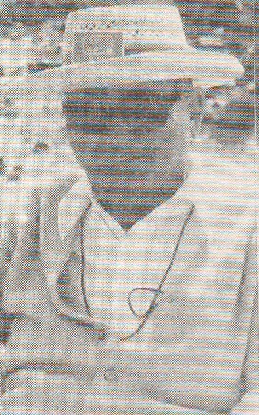
In 1965, Doig became the chief engineer of the National Cash Register company in Hawthorne, California. (Electronic cash registers. Think of the market demand!) In 1972, he moved to Dayton, Ohio to become an assistant vice president for international product development with the firm. This job required a lot of international travel. However, given his location in Dayton, he became active in Dayton-area RC clubs, including some that were just getting into the new world of RC soaring. He returned to San Diego in 1975. Its not clear if this was a process of retirement or to be closer to his parents or both (or neither). But his return to San Diego was absolutely to TPG’s great benefit as Al had an impressive ability to make friends, welcome people to the hobby, and do so with a smile.
The first mention of Doig in the TPG newsletters came as a result of the “TPG Pro-Am Contest” that was held on September 14, 1975 at Hourglass Field. This event teamed an experienced pilot (“Pro”) with a novice (“Am”) and was the brainchild of Jim Pike, a founder of the TPG and father of Kelly Pike, the club’s first President. The tasks were three flights of 3, 4, and 5 minutes each with the Pros having the option to try for double the time, getting double points if they made it, but only half points if they did not. If the minimum time was not completed, the Pro would receive zero points. The Ams would get one point per second, up to their max. For the Pros there was a landing circle of 20 feet diameter. For the Ams the landing circle was described as “huge.” Fifty points were awarded for landing in the circle. Pros were allowed to launch for Ams as many of the Ams had never been on a winch before.
25 pilots showed up for this contest. For better or worse, Al Doig (placed in the Amateur category) was paired with Larry Fogel (who was considered Pro). (For those who have a good memory that should give you pause for concern right there as Larry was in general more of a fun-fly guy than a contest pilot). Together they placed 9th as a team, and individually Doig placed 6th in the contest while Larry placed 7th. Go figure! (Larry did redeem himself by finishing third in the regular TD contest the following month.)
Following this initial contest, Al attended many, many, many club thermal contests. He became a mainstay at the thermal field and really connected with the concept of RC soaring. He completed LSF Level I in 1975. At first, Doig started flying a Graupner Cirrus, then a Challenger, and by March 1976 he was flying an Airtronics Aquila which served him well for several years. He built an electric winch, sharing this with club members every weekend at Hourglass. In some respects, one might say he was the first club “winchmaster” although the club position didn’t exist yet. He completed his LSF Level II on April 13, 1976. In July 1976, Don Edberg, Larry Fogel, Al Doig, Mark Smith, and Bob Freymuth traveled to Lockport Illinois to attend the SOAR Nats representing TPG. They all had a great time with 42 entrants in Standard Class A, another 52 in modified Standard Class B (100” span with spoilers), and 87 in Open Class C.
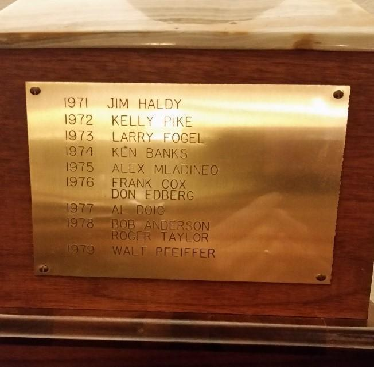
In 1977, given a lack of anyone else volunteering for the position, Al Doig volunteered to take the reins as the TPG newsletter editor. In the March 1978 issue, Al noted that “your editor finally made it to the cliffs. Despite popular opinion, I do not dislike Torrey Pines. I’m just afraid of heights and Steve Neu…Whilst munching on Dramamine I crawled to the RC pit area. Though I had arrived two hours past the time the contest was to commence, it hadn’t. I said ‘you guys better start flying before the wind comes up.’ That’s when Steve Neu got a funny look on his face.” Al did a fantastic job as TPG newsletter editor, always keeping things light and fun. Every contest he attended resulted in a write up with a report and photos, even if he wasn’t the contest director. Given he attended just about every contest possible, this was a lot of writing! It seemed the guy was always writing or taking photos or both. Al and many TPGers attended 1977 NATS which were held in Riverside, and the 1977 LSF Annual Meet held at Dominguez College. Al’s thermalling improved significantly that year as well and he took first place at the TPG 2-meter contest in October 1977. That year he placed 5th overall in the club for thermal duration, and 2nd in 2-meter. For all of his many efforts in keeping the club newsletter going amongst contest after contest and helping others join the fun, Al was awarded the 1977 TPG Modeler of the Year trophy at the awards banquet in February of 1978. He continued as editor / club photographer for another 2-3 years. Mention the name Al Doig even today and many longer endurance TPGers will remember him and his wife Rita with a fond smile.
*|caption: Al and Rita Doig at Hourglass Field*
At this time Larry Fogel was authoring the RC soaring column for Model Builder and Al Doig was doing the same for R/C Modeler. As such TPG events, designs, and members made their way into these columns for readers across the nation to appreciate. This helped expand TPGs reach considerably. Doig had a tradition of ending most articles with a friendly “Howzat!” Don Edberg’s tenure as RC Soaring columnist for R/C Modeler started after Doig.
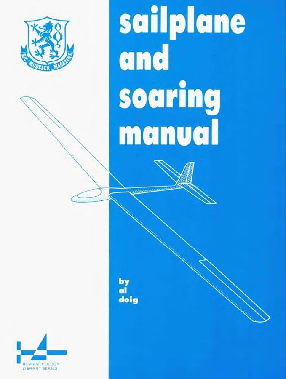
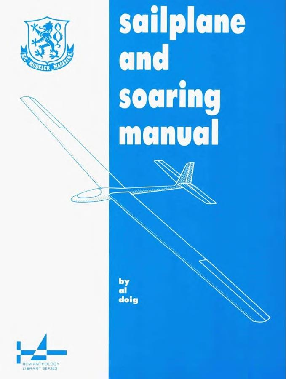
In 1981, Doig authored a very well known and loved Sailplane and Soaring Manual offered by R/C Modeler. (BTW those interested in seeing this guide book can find it available for free7). His book focused not only on general techniques for design and construction, but also soaring methods. Given Lee Renaud had just recently finished the Airtronics Olympic 650 design, the latter half of the book is essentially a detailed manual for the construction and flight testing of this aircraft. If you ever wanted to know anything about an Oly 650, this is the book for you! And at that time, Doig shifted to flying the Oly 650 regularly with the club as the new 2-meter class (Class B) was really gaining in popularity.
Doig covered the 1983 RC Soaring World Championships which were held in Sacramento. This was the event where American Dwight Holley took first place and TPG’s very own Don Edberg placed 7th. Doig’s column reflected his wonderful humor. He wrote, “In choosing a world-class soaring site, Sacramento, California, in July, would not have been my first choice; it can get a tad warm. The site was a sheep ranch with close cropped hay stubble. Although some contestants were less than enchanted, I thought the site quite acceptable. By standing on a box, one could see the nearest shade, which turned out be a tree, two hundred miles away.”8
Later Doig developed and wrote the R/C Modeler plans and instructions for Mark’s Models Bird of Time. He was an early champion of Dodgson designs, especially the Windsong, flying various versions at contests throughout the west and into Canada. Doig completed his LSF Level IV (October 25, 1988) but unfortunately never was able to achieve Level V. He passed away November 4, 2003 and continues to be missed by many in the club.
References
1) “Doig’s ULTI” R/C: Ultimate in Multi” American Modeler, May 1959
2) “ULTI Multi Radio Control System” American Modeler, July 1959
3) http://www.rchalloffame.org/Manufacturer/Doig/index.html
4) http://www.rchalloffame.org/Exhibits/Exhibit11/index.html
5) “The Age of Proportional: Realism” R/C Modeler, December 1964
https://rcbookcase.com/data/media/2/RCM_December_1964_Vector.pdf
6) “To Fail Safe or Not” R/C Modeler, March 1965
7) https://rclibrary.co.uk/title_details.asp?ID=1062
8) RCM 1981, pg. 74