 Welcome to Torrey Pines Gulls
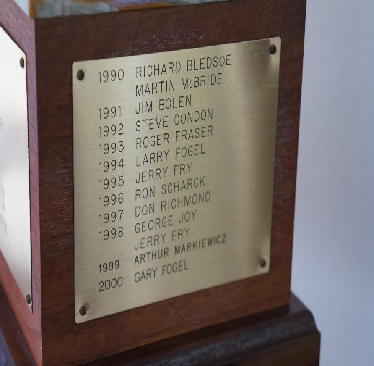
Arthur Markiewicz – Modeler of the Year – 1999
Arthur Markiewicz was born in Detroit, Michigan in 1951 to immigrant parents. His father Bruno was a carpenter and also a dedicated free flight model aircraft enthusiast and member of the Detroit Balsa Bugs. As a child, Arthur grew up as a member of the Bugs. Bruno was heavily into competition and as a result so was Arthur. They flew all types of free flight competition, both indoor and outdoor, everything from Nordic tow line gliders to rubber-band powered aircraft to hand launch gliders, etc. While Bruno was more interested in rubber-band power, Arthur gravitated to gliders. Together they travelled throughout Michigan and Ohio attending contests as father and son on the weekends. They also attended and competed in six national contests, winning a few trophies.
Bruno was friends with Erwin Rodemsky, a well-known expert in free flight who developed the Pennyplane category. Just prior to one nationals contest, Rodemsky provided a high-quality piece of ¼” C-grain balsa to Arthur and suggested it would be perfect for a great hand launch glider. Arthur used the balsa to create his own new design based on the popular Sweepette, and used this to set a national record as a senior for indoor hand launch glider at Los Alamitos. He later established another national record as a senior. Arthur was hooked on gliders.
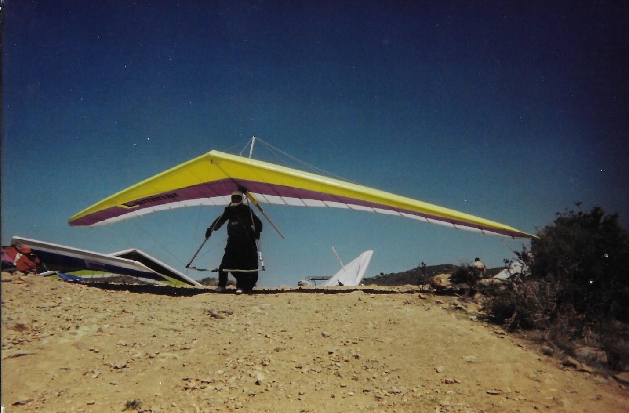
However, during his late teenage years and into his 20s, Arthur developed other interests, and was married at age 21. He found an apprenticeship at Chrysler in the design department. There he learned the trade of clay modeling of small and large car prototypes. At this same time, Arthur discovered a love for the burgeoning sport of hang gliding. Living in Michigan, this meant making trips to fly along the ridges in Tennessee but the drives were worth it. For 10 years he continued with hang gliding and his profession of clay modeling, having completely stopped any model aviation. However, following a divorce around 1980 he rediscovered the joy of RC models and added them back into his life including the typical starter aircraft of the time including a Wanderer and Gentle Lady.
Arthur moved from Detroit to Newport Beach to work for Toyota in their design department. Two years later he relocated again to work for Nissan at their new satellite design center in San Diego near Scripps Memorial Hospital. The environment of southern California provided ample opportunity for soaring. Arthur used this opportunity over the next 10 summers to fly hang gliders in the Owens Valley, making many flights of over 100 miles. His longest flight was 168 miles.
He also met his second wife at a gliding festival outside of Ramona. However, experiencing back problems, he was forced to give up hang gliding and as such re-engaged with RC soaring. At that time in the late 1980s and early 1990s there were two RC soaring clubs in San Diego County running thermal contests, the Torrey Pines Gulls (TPG) and the North County Clouds (NCC) in San Marcos. San Marcos was a bit closer to Arthur’s home in Encinitas and the landing surface wasn’t as hard as the asphalt at Hourglass Field that was used by the TPG. He joined both clubs and enjoyed flying with new friends.
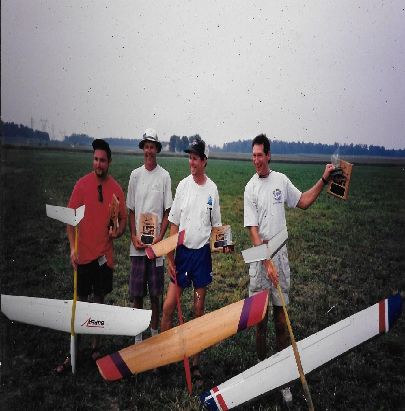
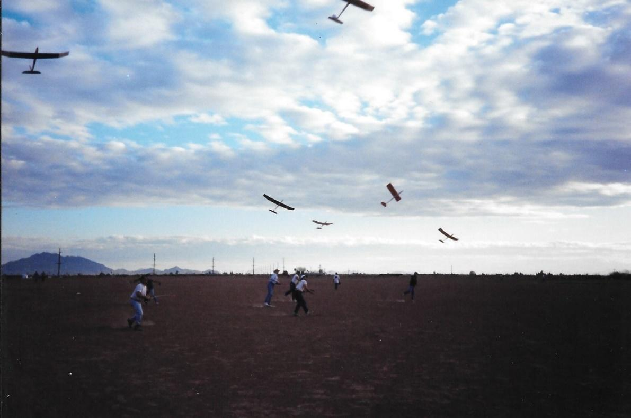
His timing also couldn’t have been more perfect as he joined just as the TPG was ramping up on hand launch glider competition with the new International Hand Launch Glider Festival. Arthur found a new world of design, construction, and competition that coupled well with his considerable experience and skill in the air. As Arthur described to me in an interview, it was a time when it was possible to design and build something in your garage that would be better than what was available commercially. Many of the top pilots invented their own new designs and brought them to the IHLGF. Arthur remembers Joe Wurts showing up one time with an 11 oz aileron HLG and outperforming polyhedral 2-channel ships. Another top pilot Daryl Perkins flew a Logic with an extended tail boom. Arthur liked that design and began to build his own version called the Flamingo as it used pink foam instead of blue foam for the wings. He was taught the art of vacuum bagging by TPGer Don Van Gundy, and found an amazing set of knowledgeable new friends in this growing area of RC soaring. Arthur routinely placed in the top 5 of the first years of the IHLGF, many years as TPGs top competitor in the contest.
.
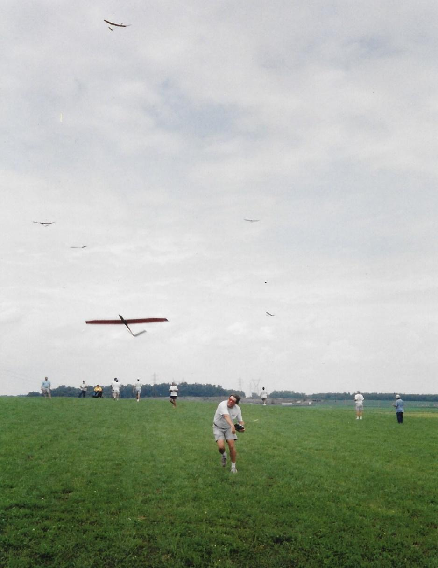
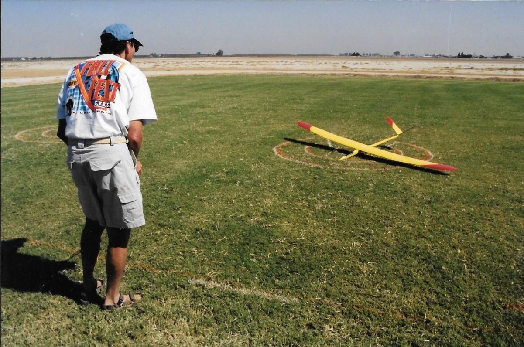
Arthur also enjoyed thermal duration competition both at San Marcos with NCC and Hourglass with TPG. He did well at the SC2 contests, and won the regional championship one year. He also competed with 2 meter gliders and for three or four times in the mid-1990s attended the RC soaring NATS in Muncie along with Don Richmond, Ron Scharck, George Joy, and other TPGers. Not being restricted only to competition soaring, he began to explore dynamic soaring at the Poway slope and scale soaring at Torrey Pines. Arthur had heard of Torrey from his earliest days in hang gliding as it was a Mecca for both sports. And while he had returned briefly to hang gliders in the 1990s, by 2000 his knees made the decision that hang gliding was no longer an option. However, at Torrey those paragliders looked very interesting. Soon Arthur took lessons and found himself enjoying both paragliding and RC soaring as both are exceedingly convenient and fun. As Arthur noted to me, “it’s a nature thing – I don’t understand why more people don’t do this!”
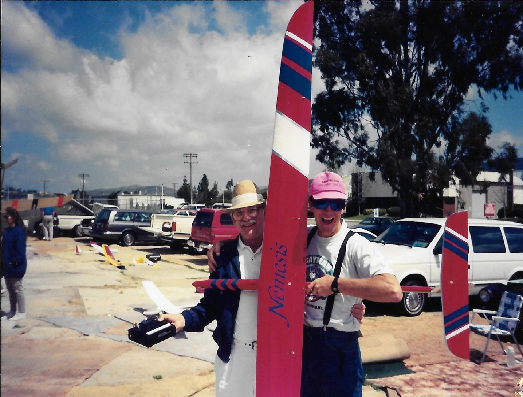
Arthur has always been a solid ambassador for the sports he’s involved with. RC soaring is no exception; he has taken the time to train many people and get others hooked on the hobby. Now in retirement, he tries to fly at least something every day either at Torrey or from his driveway in Encinitas. According to Arthur, “This hobby has been very good to me in many ways. It has gotten me through bad times in my life choices and the good….I feel very lucky that my father showed me how to build things. It not only led me into the car design business, they hired me because I could work with my hands, but also gave me the gift of flight. Priceless I say.”
TPG awarded Arthur with the Modeler of the Year trophy for his efforts to help encourage new participation in the hobby. Also it was the case that at one of the 1990s NATS, Arthur set a strong example of sportsmanship. Leading the event, he landed and lost his skeg on landing. Given this was a penalty he went to the contest director to report the lost part but the CD didn’t see the incident in person and, well, if it didn’t happen, then there was no penalty, right?... Arthur had been taught at a young age that cheating should never be a part of competition. So, he went back out to the field, collected the lost skeg, brought it back to the CD and insisted on taking a penalty, a difference in points that caused him to lose the championship. Word of this sportsmanship spread and had a positive effect on everyone. His Modeler of the Year award was also due to this positive effect Arthur has on others. Thanks Arthur!