 Welcome to Torrey Pines Gulls
Don Richmond – Modeler of the Year – 1997
Don Richmond grew up on a farm in Upstate New York in the late ‘30’s and ‘40’s, at a time that was near the end of the “barnstorming era” where airplanes were still rare and fascinating. After WWII, Don convinced his mother to finance the acquisition of a stick and paper model airplane kit. She wasn’t that keen on the idea and did not like the smell of the glue and later the dope. But Don’s pleading prevailed and for a couple of months during the winter he toiled, grumbled and cried (too young to curse) as the parts were put together. It was a free flight plane with plenty of dihedral; an .049 motor covered with red and white silk span.
On a beautiful spring day, the model was trimmed for a gentle glide, a few ounces of fuel added and the motor started. A gentle toss into the wind and it was off in a gentle climbing turn. Don recalled, “What I know today as about 300 feet it was still climbing. Perhaps somewhere around 4-500 feet the motor stopped (too much fuel) and a nice turn in the other direction followed. Wait – it’s still climbing. How can that be?? The motor is stopped. But climb it did. Across the field, across the road, over the woods (He was following) and over the swamp – never to be seen again.”
Don’s first thermal wasn’t his last but at the time, financing another model airplane for the hobby wasn’t in the cards. Roughly ten years later, in 1957, Don enlisted in the Navy and proceeded through the Naval Flight Training Program at NAS Pensacola. He would later go on to fly a wide variety of fixed-wing aircraft including the T-28 Trojan, T-34 Mentor, C-45 Expeditor, HU-16 Albatross, T-1A Seastar, FJ-2/4 Fury, T-39D Saberliner and the C-12 Huron. While in Pensacola, he met his future wife, Brenda. Brenda had two younger brothers ages 12 and 10. Don saw the opportunity to reengage with model aviation and purchased a control line kit to build with the boys. After considerable building, Don recalled, “We stretched out the control lines checked for proper operation and proceeded to start the engine. We had agreed to have the younger brother hold the plane while the older boy and I tried to fly it. The moment arrived, the signal was given and the model moved smartly into the wind. Up and up but wait – it’s doing a wing over – it’s headed for us – run!! It flew right through the area where we had stood, stretched out the control lines and crashed at the edge of the park. A review revealed that we had forgotten to put some lead in the outboard wing to balance the weight of the control lines. Eventually it flew successfully albeit dizzyingly.”
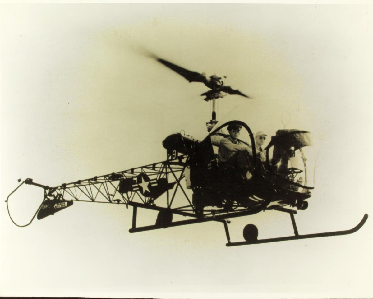
While in Navy flight training, in 1960 Don made a transition from fixed-wing aircraft to helicopters. Over his career he became one of the more accomplished helicopter pilots in the Navy, flying many types and stationed at a variety of locations. He flew the HTL-4 Sioux (a variety of the Bell H-13 similar to the ones used on the TV show M.A.S.H.), Piasecki H-25/HUP Retriever, the H-19 Chickasaw, H-34 Seahorse, H-53 Sea Stallion and HUK-1 Huskie. He flew many hours in the SH-3 Sea King while commanding two squadrons and completing a deployment to the Western Pacific with USS Enterprise and Airwing 15. He attended U.S. Naval Postgraduate School at Monterey, California in 1966, graduating with a B.S. in engineering science in 1968. After this he was assigned to Helicopter Anti-Submarine Squadron Four (HS-4) in San Diego.
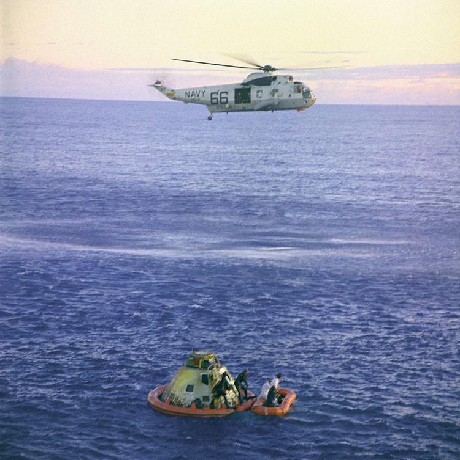
During this time, HS-4 was assigned the task of retrieving Apollo 8 astronauts after their splashdown in December, 1968, using the SH-3D helicopters. For the Apollo 11 mission, LCDR Richmond was assigned the task of piloting one of the helicopters to retrieve the astronauts from the Pacific on their return from the Moon. Following extensive training with a boilerplate steel replica of the Apollo command module, locator beacon, and specially-trained SEAL teams to secure the capsule with floats, Richmond took off from the deck of the USS Hornet in one of four Sikorsky SH-3 Sea King helicopters. Their mission put them 30 to 40 miles away from the carrier, staggered in the likely vicinity of where Apollo 11 would return. Richmond’s helicopter happened to be the one closest to the eventual re-entry trajectory and they were the first to observe the capsule with its parachutes as it came out of the clouds and splashed down. A front row seat to history, the first humans to see the re-entry first hand.
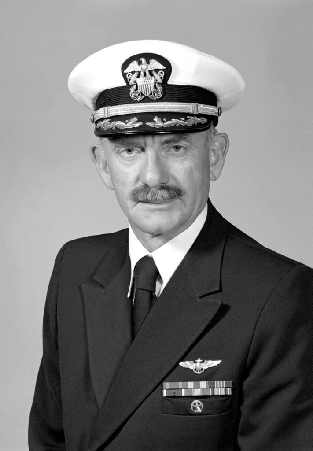
LCDR Richmond continued in the Navy, amassing over 6000 accident-free flight hours, having qualified in more than 30 aircraft from prop to heli to jet, and having earned the Meritorious Service Medal, Navy Achievement Medal, Meritorious Unit Commendation, Battle Efficiency “E”, Navy Expeditionary Medal, National Defense Medal, and Armed Forces Expeditionary Medal. He had command of HS-2, served a tour in the Pentagon and had command of HS-10 in San Diego. For a time he was on the staff of the Commander of the Naval Air Force, US Pacific Fleet in San Diego into the 1980s. From 1982-1984 he was the Commanding Officer of NAS Alameda. He finally retired from the Navy in 1986.
In 1989, Don’s oldest daughter and her husband came to San Diego for the Christmas holidays. Given both Don and the son-in-law shared an engineering background, Don thought once again that perhaps a model airplane project would be fun. At a hobby shop in Encinitas, he purchased a Kyosho 2000, a 2-meter span RC motorglider with a 03 motor running on 6 NiCd batteries. Don recalled:
“A couple of days for us working together to assemble and shop test it and it was time for the flight test. We drew straws to see who would go first. I won the honor. Motor and controls checked well so it was tossed into the wind. Almost immediately I wished we had put some color on the white wings! I managed to make a couple of turns and then tried a landing. Overshot the first attempt and did a touch and go on a chicken coop on the second attempt. This unfortunately broke the folding prop. In those days no replacement parts existed for electric powered sailplanes. With some MacGyver-like tinkering a fixed prop was fitted so son-in-law Matt could have his turn the next day. We put some color on the wing before the next flight and I cautioned him not to let it get too far away before turning back. Well, he tried but to no avail. He could not keep it coming towards us. Away it went into the upper reaches of a neighbor’s Eucalyptus tree. Approaching said neighbor with a big smile and a question about the location of our model, they assured us it had passed overhead and landed at the Carlsbad airport. After a quick scan we spotted a wing in the tree and the fuse standing up in the garden next to the tomato plant!”
After that experience Don was hooked on RC. He increased the inventory of electric-powered aircraft, flying with a loosely organized group of RCers in Carlsbad. One of these RCers was Ray Smith, a member of the Torrey Pines Gulls. Ray helped Don as an instructor but also steered Don towards RC gliders. Soon Don purchased a House of Balsa 2x4 and a Goldberg Gentle Lady. He later continued with electric by adding a Mini-Challenger and an electrified Gentle Lady.
Don attended his first TPG meeting, in January of 1991. He was impressed by the number of people at the meetings, the exchange of information, and friendly camaraderie. He attended his first thermal duration contest soon thereafter, flying a used Sagitta 900. At the time, TPG hosted some of its TD contests at Montgomery-Waller Park and this first contest was at that location. Don recalled, “I invited my wife and children to come and watch. Not being familiar with the winch procedures, I had others run the winch while I flew the model. Things went well for a couple of launches and then disaster! In an effort to gain more altitude in the zoom, I pulled too hard. One wing separated and then the other while the fuse became a lawn dart. The family was not impressed and rarely attended other contests. Oh well!!”
Fortunately, Ron Scharck joined the TPG in 1992 and together Ron and Don used considerable efforts to galvanize club activities. At the time it seemed that the club lacked a “base” for thermal operations with activities a several sites including Hourglass Field (Mira Mesa), Montgomery-Waller (Chula Vista), Bay Terraces Community Park (South Bay) and with the North County Clouds at their field in San Marcos. A new thermal field at Poway was identified by Jim Bolen with arrangements made for TPG’s use starting in about 1993. This helped to centralize activities and bring club members together. Don, Ron, George Joy, Mike Smith, and others did a lot of the work to help prep the field for thermalling.
In retirement from active duty in the Navy, Don, and his business partner, started up a computer hardware/software company called Scott Systems. At the same time TPG started up the International Hand Launch Glider Festival. Fortunately for TPG, Don’s lead programmer at the company was also an R/C pilot, and Don convinced him to write a program to build the rounds and heats from random selection for the IHLGF and to compute scores upon completion. Meanwhile, Don recorded a timing program in his home bedroom so that the various countdown requirements for the different rounds could be played over an audio speaker. According to Don, “My dear wife thought I had lost it!!” This all worked out well with Don’s wife Brenda helping with the scoring during the first handful of IHLGFs at Poway. These important tools were later re-designed by Tom Clarkson.
Don continued to build and fly various RC sailplanes including an Alcyone, Climmax, Compulsion, Addiction and other sailplanes. This changed the year that Fred Sage brought a new R\&R Genesis to one of the club meetings. Don ordered one immediately and flew it in many contests. But “one day at Poway the launch was imperfect, the model stalled and broke hard left. You may recall a utility pole just to the left of the launch area. Well, the impact was tremendous! It rained fiberglass for five minutes as pieces and parts fluttered to the ground. Gone in a heartbeat! The good news was that we got to see how the molded processes worked inside the wing. Lots and lots of spluge!!”
The photo below is from the 1993 Nationals. As related by Ron Scharck, the story goes:
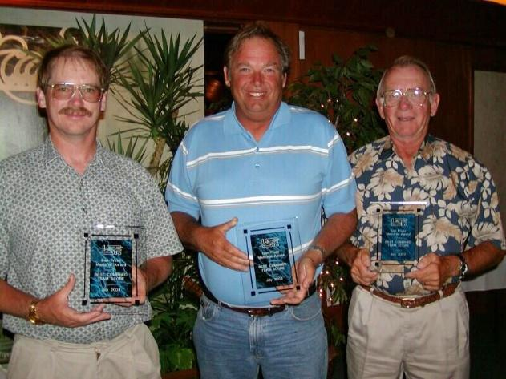
“Realizing that neither of his new teammates were currently TPG members, Don, prior to the beginning of competition, officially recruited Joe and Larry as our two newest TPG members. Great recruiting job, Don!
Done as more of a “lark by three guys that had nothing better to do” than seriously contemplating winning, the TPG team, carried by the stellar performances of Joe Wurts and Larry Jolly, won the 2003 Dan Pruss Memorial Team Award. As Don recalled: "Joe and Larry are not only good fliers, but are extremely strong to have carried me for four days and still finished ahead of everyone. A great thrill for me!" Don, everybody has their role. Yours is Membership Recruitment! As a side note, the names of TPG members have been recorded in the pages of the AMA National Championship and World Championship records many times over the years. It is this legacy, borne out of national and international competition that has helped make the name of Torrey Pines Gulls known and respected world-wide.”
In 1994, Don Richmond was part of the team that helped run the soaring NATS at Lubbock, Texas along with George Joy and Ron Scharck. Since that time Don has attended every RC soaring Nationals with the exception of 1997, 2011, and of course 2020 because of the pandemic. He flies “all the events” and has placed several times, winning electric unlimited one year and 1/2A sailplane. He remembers the drives from San Diego to Muncie and back with Ron Scharck as being great times but long drives. Between Don, Ron, and Arthur Markiewicz, some great stories could be told.
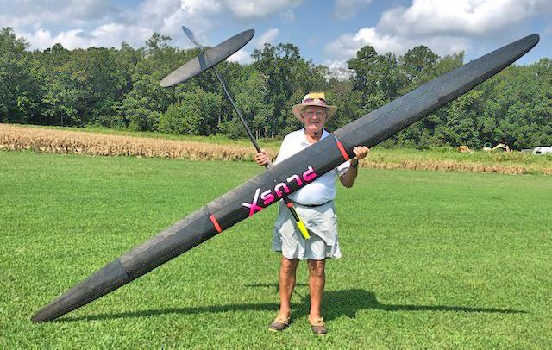
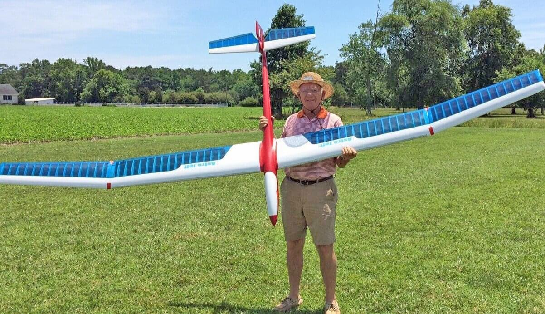
Don started an internet company, Hilaunch.com, to provide small hard to get commodities to the RC soaring community such as CF spar tubes, aluminum joiners, horns, bell cranks, tape, etc. In 1994 Don also purchased a Supra and enjoyed flying it at many contests. He jumped into ALES/F5J in the mid-2000s, with the purchase of a Maxa, and later a Maxa light, a Volo, a Plus, a Plus X, and more recently a Vixen 2. He also enjoys aerotowing, both the soaring part and the towing part. In 2010, Don and his wife Brenda moved to Virginia Beach, VA to be closer to their three children and seven grandchildren. Unfortunately, Brenda passed of liver cancer in 2011. But Don continues to enjoy RC soaring in a variety of forms, and as he said “I started R/C flying when I was 54 and continue at almost age 86. My motto: It’s just a number. You are never too old!!”
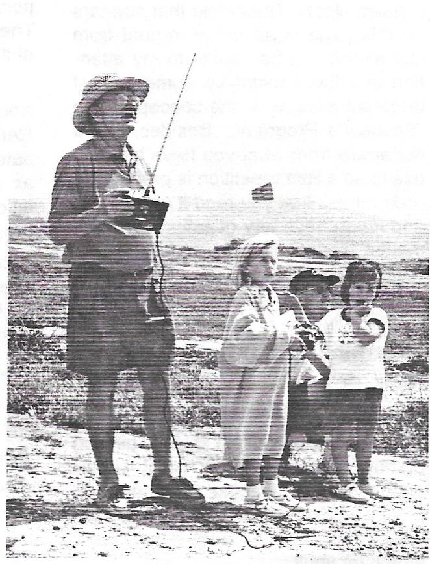
*|caption: Cool Hand Luke Don Richmond using a buddy box at Torrey Pines to
train some hopeful TPG future members in 1997.|*
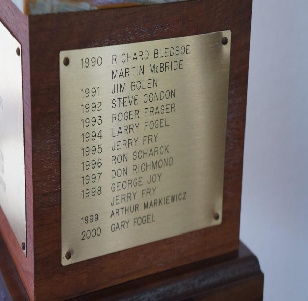
Torrey Pines Gulls honored Don as Modeler of the Year because of the tremendous effort he put in as President of the TPG in 1997. He remains a continued friend of the TPG and wishes to be remembered to everyone.