 Welcome to Torrey Pines Gulls
Frank Cox – Co-Modeler Of The Year - 1976
Frank Cox was an outstanding member of the Torrey Pines Gulls. Born and raised in San Diego, he was a graduate of San Diego High School. Not only was he born and raised in San Diego but his father was none other than “Frank the Train Man” who operated a famous model train store in Hillcrest. With that upbringing one would think that a son would be interested solely in model trains. But not so, the son became interested in free-flight model airplanes instead. A gentleman down the street from their house was the owner of Hillcrest Hobbies. Growing up in the 1940s and 1950s, Frank Jr. would save his paper route money to purchase free flight kits from the hobby store. While at San Diego High he also bought a camera and became hooked in the world of photography.
After high school Frank enlisted in the US Air Force and was stationed for a time at Whiteman AFB. After leaving the Air Force, he pursued a degree in engineering, eventually becoming a computer programmer in Florida. While computer programming paid the bills, on the weekends he would display his photography at local arts and crafts shows. The artists were largely unorganized, and Frank began maintaining a computer database of art shows and selling the lists. This led to the opportunity to organize his own increasingly large art shows, with the first being in 1972. Given the family location in San Diego, he spent the winters arranging events in Florida and the summers arranging events in San Diego.
One fateful day in 1975 or 1976, Frank somehow found his way to the Torrey Pines Gliderport. He was amazed! Here were “free flight” models but they were under complete control and with no gas motors! He was hooked instantly. His first kit was a Mark’s Models Wanderer. Many TPG members took their time to help teach and encourage Frank, and he was very grateful for the support. In return, Frank took many pictures of people and activities at Torrey and at the Hourglass thermal field and shared them with the membership via the newsletter. He captured a lot of great club moments on film. Frank graduated to a Mark’s Models Windfree and then fell in love with the Hobie Hawk. When I say “fell in love” I mean that Frank and Hobies were never separated again. He REALLY loved the Hobie.
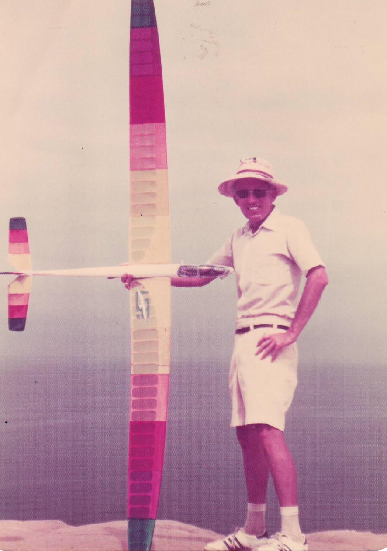
It took him a while to get interested in thermal soaring at Hourglass but the Hobie filled both thermal and slope roles quite well. In the morning he would thermal at Hourglass, and then when the winds came up he’d drive to Torrey in his convertible Cadillac for the rest of the afternoon (this was a common strategy for many in the club, except for the Cadillac). At the time, most thermal contestants covered their planes with a dark underside on the wings for improved visibility. However, eventually someone would invariably mistake someone else’s plane for theirs in the sky – leading to a catastrophe. To avoid that confusion, Frank covered his Hobies in a unique transparent rainbow pattern. In addition, the Hobie’ elliptical wing made it difficult to monokote with one sheet and Frank figured that by dividing the curve into squares of different colors it would make it easier to cover. Lastly, Frank observed that depending on the angle of the sun, the clouds, etc. that one or another color of the rainbow would “pop” and be more observable than the rest and if he had all colors on the wing, he’d cover his bases!
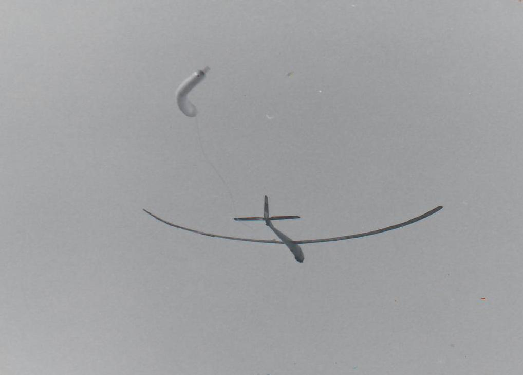
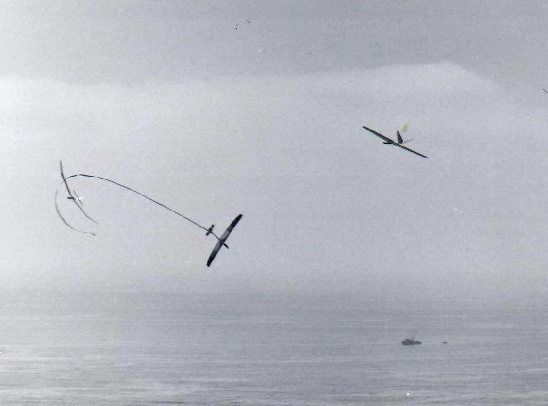
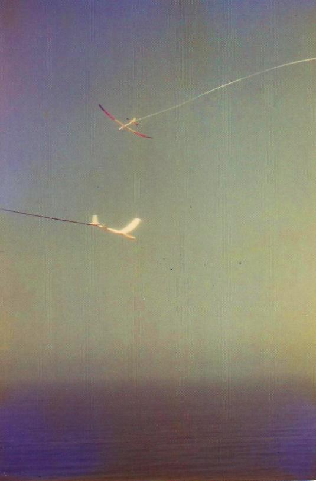
Frank made flying fun for everyone around him. At Torrey, one day he wondered what it would be like to fly with a paper streamer behind the Hobie, simply to show the path of the plane for aerobatics. It turned out to be too good of an idea. Upon seeing the streamer, other pilots wondered if they could cut the streamer off the tail of the Hobie. Thus, “Hobie combat” was born. Hobie combat became a fun but expensive adventure, as multiple times people ended up mid-airing with the Hobie instead of the streamer. But eventually “rules” were generated where whomever caught the streamer from the Hobie would then become the next target, unless they could safely land with the streamer on the top of the cliff. Super Cheetahs were really good for this mission as their hard duralene fuselage would take considerable abuse - far more so than a Hobie.
Frank’s gem and craft shows grew and grew. While wintering in Florida, he flew RC with members of a soaring club near Cocoa Beach and also with the Orlando Buzzards. But unfortunately, he also developed a skin condition and upon doctor’s advice had to refrain from activities in the sun. It’s hard to live in Florida or San Diego and avoid activities in the sun, but by the late 1980s, Frank was forced to give up RC soaring. He continued to run his popular gem and craft shows as “Frank Cox Productions” until the Covid-19 pandemic.
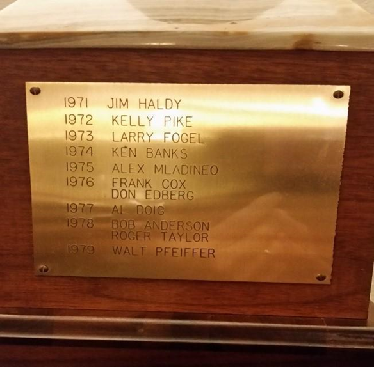
Frank was honored with the TPG Modeler of the Year Trophy in 1976 for all of his efforts to help promote the club through photography (and perhaps in honor of the significant number of lost Hobie Hawks).