 Welcome to Torrey Pines Gulls
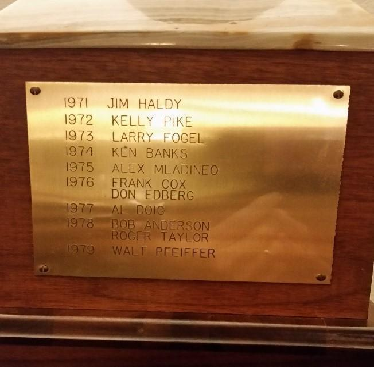
Ken Banks - Modeler of the Year - 1974
C. Kenneth (Ken) Banks was born in Detroit, MI and moved to New Jersey as a first grader. By the time he got to junior high school, he found control-line models to be his thing, flying a variety of gas-powered kit planes for fun/combat and sometimes with three-wire throttle control in the school yards (throttle control was a new thing back then!). After graduating high school, he was accepted to Harvard and sold off most of his models when he moved to Boston to go to college. After graduating with a bachelor’s degree in physics in 1965, he moved to California to begin graduate studies at U.C. Berkeley. However, the physics department wasn’t welcoming and the campus was in the middle of the turmoil of the 1960s. He found a summer job at NOTS China Lake in 1966 and liked it so much that he left U.C. Berkeley and moved to China Lake. While at China Lake, control-line models re-entered his life, and he was introduced to radio-control, first using a single-channel pulse proportional radio, and then building a Heathkit transmitter for a four-channel powered RC model. Ken also experimented at this time with a large foam RC glider on a tow line, but it flew terribly and didn’t really show the true value of RC soaring.
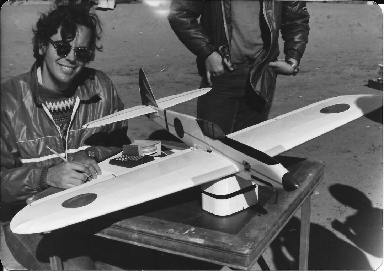
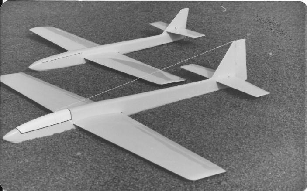
Ken wanted to continue his education in physics and chose the applied physics program at U.C. San Diego. He brought a few RC powered aircraft with him to San Diego, including a Top Flight Headmaster (48” high wing) and an Andrews A-ray (also a high wing) and flew these at the abandoned Del Mar Airport which was just southeast of the Del Mar racetrack (Interstate 5 now bisects the former runway). But what do you know, right next to campus, he found the Torrey Pines Gliderport, and the fledgling group of Torrey Pines Gulls modelers. This kind of gliding seemed pretty cool! He built a Mark’s Models Windward and several other planes, and began flying with the club in about 1971. He used his physics background to begin designing planes, including a series of up to 2-meter wingspan sailplanes called “Ocotillo.” He became interested in both thermal soaring at Hourglass Field and slope soaring at Torrey when he wasn’t busy studying at U.C. San Diego. Ken was an early convert to electric flight (brushed motors and nicads), with both an electric version of the 2-meter Ocotillo and his own design as a pylon racing and aerobatic aircraft.
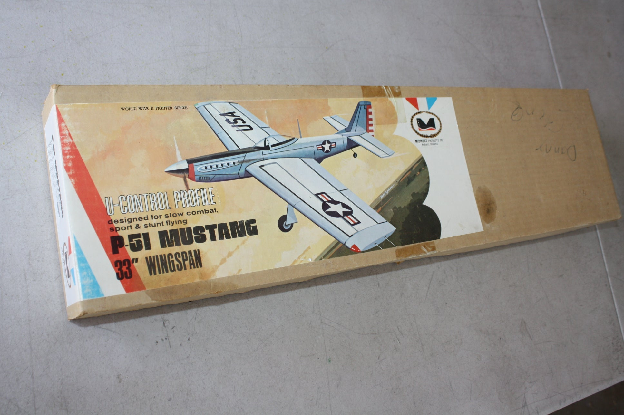
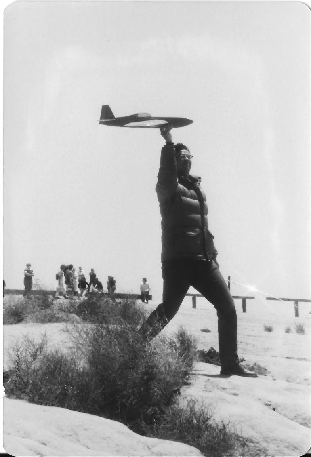
Given his background with control-line, Ken thought of the idea of installing RC gear in a profile control-line model and then slope soaring it at Torrey. This worked, and became very popular with the club as the U-control kits were rather inexpensive and easy to find at the local hobby shops. It became so popular that slope races using only control-line models converted to RC became “the thing” at Torrey in 1974-1977. Ken’s first attempt at this was with a Flight Streak. As the idea gained popularity, the Midwest P-51 Mustang (pioneered by Buck Faure) was a frequent choice for RC conversion with the radio gear just thin enough to fit within the thick airfoil at the root, with a standard flat 4.8V NiCd pack cut into the nose. Consider these to be some of the earliest home-brew “power slope scale” (PSS) slopers. However, Control line designs offered the opportunity for very tight slow speed maneuvers. When Ace finally released a transmitter that was flaperon-capable, it was possible to accentuate the pylon turns even further with a bit of snap flaps. Ken also helped club members modify their foam Canyon Products 1-26 Schweizer model sailplanes to make them fly better, and there were also pylon races for these.
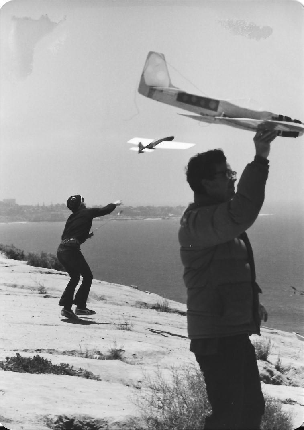
Fortunately for the club, Ken was also quite a writer. He began writing articles for the newsletter in 1974 – his first topic was “radio and control system installation” – this spanned two or three issues. After Larry Fogel was elected club president in 1975, Ken volunteered to replace him as newsletter editor. He did a fabulous job. Not only as editor but also author! He wrote a “how to” on the topic of converting control-line models to aerobatic stunt gliders. This was followed in future issues with articles on NiCd batteries, and a long series of articles on glider aerodynamics. These were written in an easy-to-understand manner for the club, and many members appreciated it. Ken was self-taught in aeronautics and was reading Navy textbooks and then converting that knowledge into the TPG newsletters.
1974-1975 was also a time when there was a need to help iron out differences with the hang glider community and find a path to share Torrey as a soaring resource. Together with Larry Fogel, Ken helped negotiate with the City of San Diego and the hang glider community.
In the same time frame, Ken particularly remembers when Larry arranged attendance by club members to a talk by Dr. Paul MacCready about the Kremer Prize and MacCready’s interest in building the first human-powered aircraft to fly a prescribed figure 8. (Later MacCready built the first human-powered aircraft to cross the English Channel, for a second Kremer Prize). This talk was before either flight had been accomplished, and was at a time when many complex and aerodynamically elegant designs had failed. MacCready had a great way of making complicated engineering problems achievable by thinking about problems from different perspectives, in order to find simple solutions. This mantra resonated a lot with Ken.
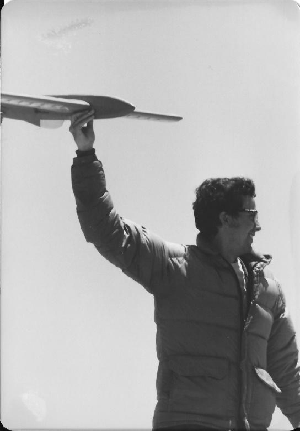
Ken then designed and built a very fast aerobatic ship called the Pterodactyl. The Pterodactyl was purpose built for those high wind days at Torrey when beach runs are particularly fun. On those days when there would be no beachgoers, he would dive down low enough to clearly see the shadow of the plane on the beach, then climb all the way back up to cliff level and do it over again. Lots of fun. In those sorts of high wind days Ken would sometimes fly with a motorcycle helmet on, to avoid tearing in his eyes from the wind and sand being blown up from the beach below. He bridged the divide between older professional members and younger high-school aged pilots. For instance, Ken is one of those who taught youngster Steve Neu how to fly RC at Torrey.
By the late 1970s, Ken had some health issues that affected his ability to pursue his graduate studies at U.C. San Diego. He passed his candidacy for his Ph.D. but moved back to China Lake before completing his Ph.D. work. He fully recovered after a few years. But by then marriage, a family and interesting work had curtailed his interest in RC. He worked as a civilian for the U.S. Navy as a systems engineer/chief engineer for various programs. His physics background was well suited to helping groups of people work together by bridging the gaps between their various disciplines. Ken served as the chief engineer on the Sidewinder AIM-9X missile during the earlier part of its development in the 1980s; this is still used in the fleet. He also has worked on the development of technology and its transition into a variety of systems, and in the development of other systems. For a period he was Chief Engineer of the Weapons Department. Throughout his career he made a deliberate decision to avoid management positions, and instead to stay up to date with technology, and learn by doing. He retired from China Lake at age 67 and soon thereafter was re-hired again and is still helping…all totaled, 50+ years of civilian involvement with the Navy at what is now NAWCWD China Lake.
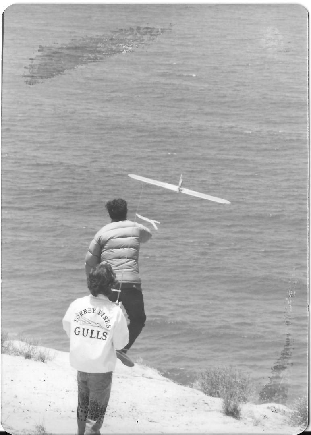
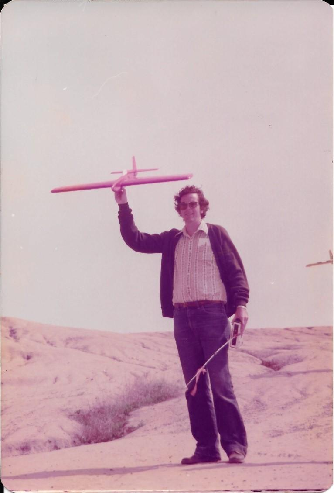
More recently, Ken re-discovered his interest in RC in 2007, specifically electrics and foamy model airplanes, including RTF, kit, and scratch-built, flying in the area near Ridgecrest. It’s a similar feeling to the time when he was engaged with the social group of TPGers in San Diego. Ken was honored in 1974 for his many efforts to help encourage others into the hobby and for helping the club as newsletter editor and encouraging a layperson’s understanding of aerodynamics.