
 Welcome to Torrey Pines Gulls
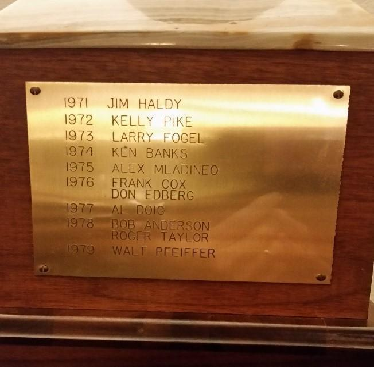
Larry Fogel - Modeler of the Year - 1973
Larry Fogel came to San Diego from New Jersey in the late 1950s to work as an engineer at Convair. A very inventive man, while in New Jersey he had invented the first method of active noise cancellation in headphones while working on projects with helicopter pilots. Once at Convair, he led programs to measure and improve the reliability of the Convair F-102, F-106, 880 jet transport and served as head of reliability for the SM-65 Atlas rocket. In the early 1960s he conceived of a type of artificial intelligence using simulated evolution to solve engineering problems, and once this was demonstrated to work, he and two others from Convair formed a new company, Decision Science, Incorporated in Pacific Beach. This was one of the first companies in the United States dedicated to machine learning and AI.
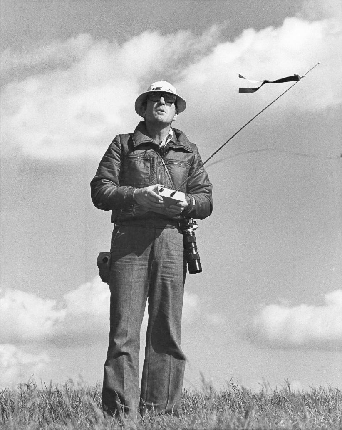
Larry was full of energy (a “type A or type A+” type of guy). RC sailboats, RC model airplanes, and music offered an opportunity to relax from an otherwise very busy life. And given lots of competition in his daily life already, he was not all that interested in competitive RC soaring but understood the joy that others received from doing so. Larry arranged fun-fly activities to get new people engaged in the club, and enjoyed just spending time flying at Torrey Pines with friends, newcomers, and his two sons David and Gary. Over time, Larry also helped identify several new fields for the club including Kate Sessions Park (where the TPG held monthly thermal contests in 1972-1973), or a thermal field near Scripps Memorial Hospital (now the Preuss School), at Hourglass Field (now Miramar College), at Morley Field (Balboa Park), at Robb Field (near Sunset Cliffs). Together with TPGers Paul Denson, Buck Fauvre, and others, he coordinated the activities of other TPGers investigating new locations for thermal soaring such as Madison High School and Pershing High School. The new club also needed a location for monthly meetings and Larry made calls to secure a room at UCSD’s Muir College, which served as the club’s initial meeting room for a few months until a larger better meeting room on the top floor of the San Diego Federal Savings and Loan bank on Torrey Pines Road in La Jolla. This far better meeting room was used monthly by TPG for many years.
By 1973, the skies at the gliderport were increasingly crowded and complex. Manned sailplanes were operating regularly and increased numbers of RC glider guiders made the members of the Associated Glider Clubs of Southern California (AGCSC) concerned. It was fine to have one or two RCers every now and then but increasingly each weekend had more and more RCers and it was becoming crowded for the manned sailplanes. Larry Fogel and Kelly Pike reached out to the AGCSC to form a solid working relationship to coordinate activities and ensure safe operations. These discussions led to definitions of “the window” and traffic patterns that became used from then on to help separate the activities during full-scale launch and landing. TPG provided a demonstration of RC soaring for the spectators at the 1973 Pacific Coast Midwinter Soaring Championships held at Torrey Pines.
However also by 1973, the number of hang glider pilots showing up and jumping off the cliff was increasing as well. These pilots, flying under the Ultralight Flyers Organization (UFO) were more interested in flying than they were in discussing safety rules. Larry served to help attempt to coordinate these activities but found it difficult to do so. The City stepped in rather quickly and on February 21, 1973 arranged for a meeting at the office of Harry Atkinson, Assistant Director of the Parks and Recreation Dept for the City of San Diego to discuss these safety issues. Representatives of the State Parks and Recreation Dept, FAA, AGCSC, TPG, and UFO were present. The result of the meeting was the formation of a three-person committee (one member from each of AGCSC, TPG, and UFO) to formulate a set of operating procedures that would be acceptable and followed by all. An initial proposal was to have hang gliders launch only to the south, and only land on the beach (this proposal didn’t last long). Larry’s efforts were central to the process of bringing these groups together and preserving safe flight operations for everyone so that the City would keep the gliderport operational. These efforts would later lead to the formation of the Torrey Pines Soaring Council in 1978.
Upon Jim Haldy’s departure from the club, Larry (who was already then serving as Secretary) took over as the club’s “Communication’s Officer.” In doing so he was officially the club’s first Newsletter Editor although Jim and others had helped keep a loose “newsletter” of sorts going from about 1971 to 1973 by various names including the very impressive newsletter title of “The Whatcha Callit.” This changed to the longer and somewhat more scientific “Journal of the Torrey Pines Gulls Radio Control Model Soaring Society (JTPGRCHSS for short or more familiarly called ‘Loose Talk’)” with Vol. 1, No. 1 issued in June 1974 with Fogel as editor. The newsletter began with Larry’s editorial: “In volunteering for this task, I hope to start a new tradition so that this journal not only becomes a newsletter but also an open forum to encourage the exchange of ideas on how to design, build, and fly superior sailplanes. Our slogan will be ‘Fewer Crashes’ and ‘Less Need for Excuses.’”
Larry also had an interest in amateur photography and began taking photos of the RC activities at the cliff and at Hourglass Field. At that time it was difficult to figure out how to get photos into a typewritten monthly newsletter. (Remember the days of typing on a typewriter and then having to go to the copier, make X copies, and then address each one, then mail and repeat this each month?) So Larry began to write articles about RC soaring for various RC magazines with an already established path. RC soaring truly was very new at that time. Most RC magazines were heavily focused on powered RC or control-line. The rapid interest in RC soaring resulted in many RC magazines starting up their own columns about the hobby in the early 1970s. Larry’s efforts eventually landed him a monthly column on RC soaring for Model Builder magazine throughout much of the 1970s into the mid-1980s. He used this forum not only to promote the activities of the TPG but also bring the RC community closer together – his business trips allowed him to attend contests around the nation, and even visit RC glider sites in Europe and Australia.
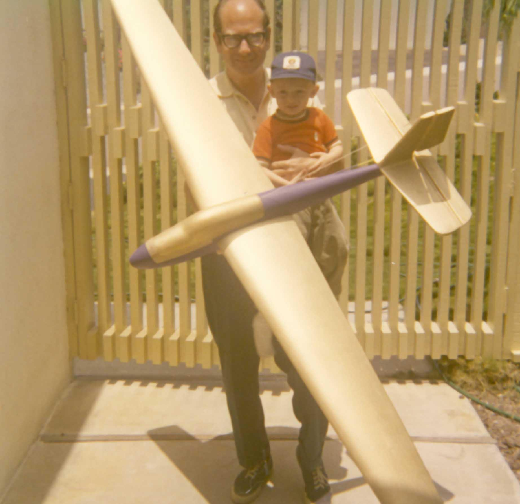
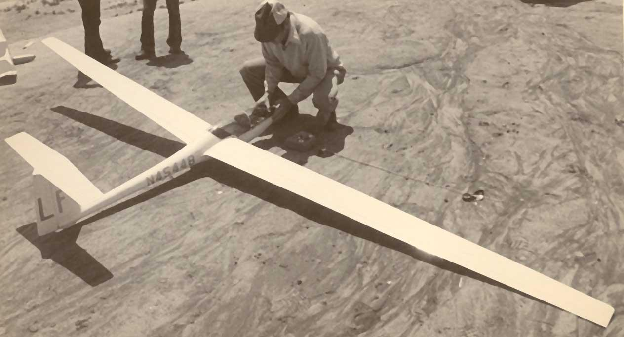
He would write about these in Model Builder, and made a tremendous number of friends around the world, who then of course would in return through Larry’s writing come to know Torrey Pines as a hotbed for the development of RC soaring. (Think about this as a sort of RCgroups, where one person is the focal point for everyone’s communication through a magazine). Local modelers such as Mark Smith, Harris Nelson, Hobie Alter, and others were always very pleased that Larry would help promote their designs and activities through Model Builder. Mark Smith was in particular so thankful for this friendship that in 1974 he gave his original prototype Windfree sailplane to Larry as a token of his appreciation.
Because of all of these activities on behalf of the club in 1970-1973, Larry was awarded the TPG Modeler of the Year Trophy in 1973. Larry passed away in February 2007. He was awarded AMA Life Fellow in 1996 and inducted into the AMA Model Aviation Hall of Fame posthumously, in 2024.
Additional information on Larry’s life can be found at:
https://en.wikipedia.org/wiki/Lawrence_J._Fogel
https://www.modelaircraft.org/sites/default/files/files/FogelLarry.pdf
https://www.modelaircraft.org/museum/history-recognition/ama-model-aviation-hall-fame