 Welcome to Torrey Pines Gulls
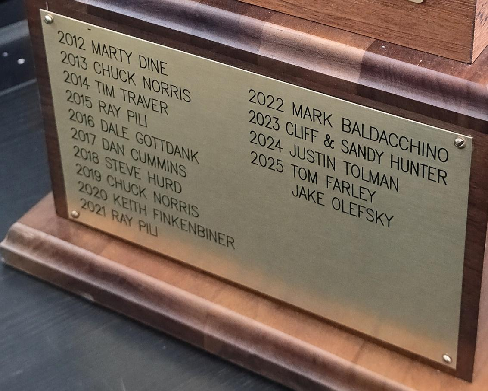
Chuck Norris – Modeler of the Year – 2013/2019
Charles (Chuck) Norris was born in Austin, Texas, the son of a Presbyterian minister and a mother who worked at the University of Texas. As a child, he enjoyed building static plastic models of aircraft, however his father’s service as a chaplain in the U.S. Army led the family to move around the United States regularly, including two moves to Germany. His first trip to Germany at age 6 started with his first flight on a commercial aircraft. Chuck was fascinated at the time by flight, the shape of the aircraft, the sounds, the aesthetics. Everything.
Chuck’s second trip to Germany (near Erlangen) occurred when Chuck was a teenager and led Chuck to witness RC aircraft for the first time. He became intrigued, but the models were very expensive. These RC models were exclusively powered models. Chuck never had the money to join in the fun. He returned to the US when he was 16 years old, finishing his primary education at a military high school in Texas. Graduating in the top 15% of his class, he was accepted into the University of Texas, Austin right away.
During Chuck’s childhood, the Apollo missions had captured public interest internationally. He remembers watching the Apollo 11 moon landing with his family at age 6 and thereafter always had an affinity for rockets. At age 7-8 he was building and flying Estes rockets. Shooting them off was fun too. It was through rocketry that he learned the basics about stability, center of gravity, design, and physics. He would make his own designs to improve things, tinker with balance, etc. This childhood experience coupled with the magic of Apollo led Chuck to pursue a degree in aerospace engineering while at the University of Texas at Austin. After a course in orbital mechanics, his instructor found him a path to a summer internship at NASA Jet Propulsion Laboratory (JPL) in Pasadena. This experience was life changing. Orbital two-body equations were amazing. The math made sense and came naturally. JPL was the center of the universe when it came to unmanned spacecraft and he recalls watching the pictures return from the NASA Voyager probe on its pass of Neptune – humanity’s first close views of this planet, from a spacecraft millions of miles away, with the engineers who had built it sitting next to him watching the same pictures arrive. It was a very special time and an amazing internship. While anyone with considerable responsibility at JPL already had a Ph.D., Chuck found that there were a lot of people his age as interns at the time and JPL fostered a great deal of “team thinking” which Chuck enjoyed. He was able to work on computers at JPL, programming a system called the hypercube in C. Just a few years later Chuck graduated with a Bachelor’s Degree in Aerospace Engineering. During the degree process one had to specialize in either aeronautics or astronautics – the choice for Chuck was already quite clear, and he designed an aero-braking Mars lander as his senior project.
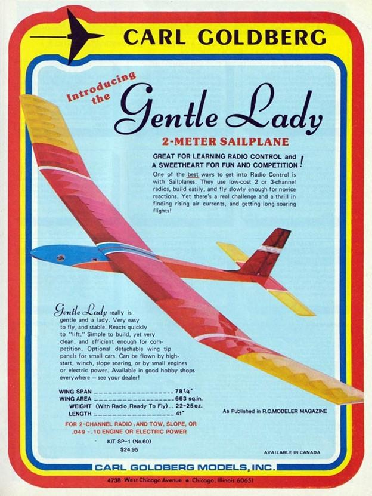
While living in Monrovia and attending JPL, Chuck found his way to the Hobby People store in Pasadena. He ended up chatting with the owner, who encouraged him to purchase and build a Goldberg Gentle Lady. It was Chuck’s first RC aircraft and the kit looked complicated but the owner promised “if you build it and come back, I’ll teach you how to fly.” Chuck spent his days at JPL and nights building the Gentle Lady in roughly 1984/1985. He installed a low-end Futaba radio system and really detailed the Gentle Lady out nicely. The owner helped him get to the Pasadena Soaring Society (PSS) who were flying on the weekends on the grass outside of the Rose Bowl. Those first flights were knee bucklers, but fun and some of the PSSers were also trying various javelin-launched gliders for fun and also doing slope soaring at various locations in the area. Chuck built a slope plane and began flying it off a hill near the 210 freeway with others. Slope was a lot of fun, but the winds were never consistent and he gravitated more towards thermalling. Armed with the Gentle Lady he was hooked, but in a search for better performance he built an Airtronics Sagitta 600.
Realizing the importance of a Ph.D. in this field, Chuck decided to continue with his education. He was accepted to a graduate program in Aerospace Engineering at the University of Colorado at Boulder. Within that program was the Center for Atmospheric Research (Earth Science) which included data processing from satellite imagery to improve our understanding of the effect of water vapor on sea temperature. This became the focus of his research, which led to his dissertation on the topic via a 6-year program. And it was at this same time that he met his future wife, Paula. And it was also here that he realized that the air in Colorado was a lot cleaner than the air near Pasadena. And it was here that he also brought all of his RC aircraft from Los Angeles as there must be places to fly in Colorado… Indeed there were, and Chuck enjoyed just flying on his own near Boulder whenever time would allow.
As Paula was eager to obtain her Ph.D. in the biological sciences, she applied to UCSD, UCLA, and the University of Washington. She got into all three and chose San Diego. So, after Chuck’s Ph.D. was complete, they moved to San Diego with Chuck obtaining a postdoc at the Scripps Institution of Oceanography in climate research with John Rhodes. Chuck had heard about Torrey Pines and its connection to RC soaring. He showed up one day and volunteered to help with a slope race that was happening that day. This was super cool! Parviz Kamiab was the main ambassador for TPG at the time at the cliff, and he and Chuck hit it off. Parviz encouraged Chuck to attend club meetings, contests, etc. His first experience at thermalling with the club was by flying his Gentle Lady rather gingerly up a winch at the Encinitas field. Realizing that the design was not really competitive, he built a pair of Oly IIS planes with Bill Eckles and together they enjoyed sharing flight time at Encinitas. Chuck focused on thermalling.
At the time, TPG was ramping up the International Hand Launch Glider Festival each year and with that many people on the field, scoring by hand per round was very tedious. Armed with his programming skills, Chuck produced a one-off online scoring system, the first one of its kind available, and used this at the IHLGF via IHLGF.com. Later, Tim Traver used this prototype for the development of the more popular F3X Vault. At this time Chuck was not yet flying DLGs, but thereafter he got into it, building his own DLG with fiberglass and wing bagging. That aircraft was short lived and folded its wing on a hard launch. Amardeep Dugal assisted with design and construction pointers, and together they built some one-off planes in Chuck’s garage with fuselages ordered from someone in Israel. With a design similar to the SuperGee, Chuck entered his first IHLGF. Other mentors began to assist him more including Mike Smith, Mike Seid, John McNeil, Gary Fogel, Parviz Kaimab, and Bill Eckles. The TPG was very welcoming.
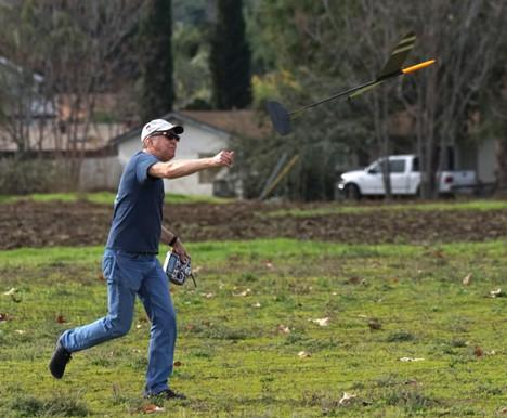
Club meetings were still being held at the San Diego Air and Space Museum and Chuck provided a presentation once on the build of his Wind Dancer. However, time commitments of a family and work reduced his available time for RC soaring. After his postdoc he started a web development company with innovative ideas about video loops. While this wasn’t wildly successful, the experience provided good lessons during an important time in the development of the Internet. Chuck landed a job with another start up and with that larger salary could afford a home in Scripps Ranch. The startup was eventually acquired by Akamai, a streaming media company for video on demand and live streaming. The co-founder CTO of Akamai, Daniel Lewin, was tragically on the first plane that was flown into the World Trade Center on September 11, 2001. Shortly thereafter, the company closed the San Diego office. For a time, Chuck worked for mp3 and then Napster, building the content delivery network for Napster 2.0 to its acquisition by Best Buy. He then once again shifted careers as first engineer and eventually CTO of Eventful, a company built to handle online events. Chuck worked here for 14 years and the company was eventually purchased by CBS and sold to Intercom, the second largest radio company. After this he worked as a consultant and currently works for a consulting firm to Meta.
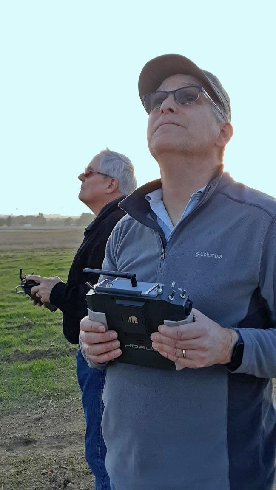
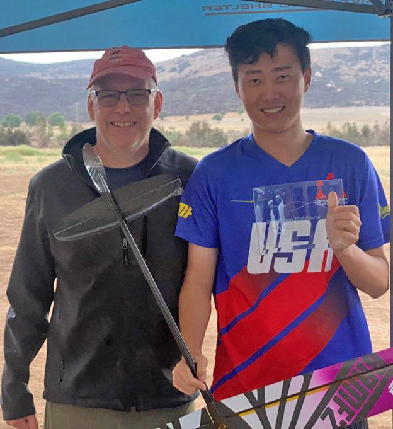
And of course, Chuck remains affiliated with the TPG serving as the club president, and previously as DLG Coordinator. For his efforts to help build the online scoring system for IHLGF, Chuck was awarded the Modeler of the Year trophy in 2013. He repeated again as Modeler of the Year in 2019 after building a timing board for the IHLGF and helping in many other ways with the club. Chuck also currently volunteers his time helping teams of students at SDSU compete with 3D-printed RC model aircraft. Thanks for all your hard work, Chuck!