 Welcome to Torrey Pines Gulls
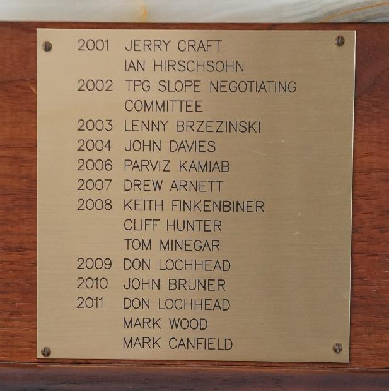
Mark Wood – Co-Modeler of the Year – 2011
Mark Wood was interested in airplanes at an early age. Growing up near El Monte, California he used to ride his bike to watch airplanes at the local airport. He made some early attempts at building stick and glue model aircraft at age 15 but most of these would be toasted shortly after they left the building board. After high school, Mark enlisted in the U.S. Navy and was assigned to the USS Kitty Hawk between 1973-1977 and learned the skills of an electrician. The Kitty Hawk was stationed at North Island, San Diego and he enjoyed his service on board the second aircraft carrier named after the location made famous by the Wright Brothers.
After leaving the Navy, Mark worked as an electrician in Navy shipyards, mainly in the state of Washington. It was there in one of the shipyard shops that he overheard someone talking about a new generation of model airplanes – those made of an indestructible type of foam. He was seriously intrigued and went to the local hobby shop to buy his first RC plane, a Multiplex Teddy. This was in about 1992. The Teddy was a basic beginner’s model with a pusher prop set behind the wing operating on a Speed 400 brushed motor and plastic prop. It wasn’t very efficient, but it was the gateway drug that hooked Mark. Soon after Mark learned of powered foam flying wings offered by Zagi. These too used Speed 400 motors in a pusher configuration and Mark and his friends enjoyed zooming around the field at Port Orchard Airport with Zagis, Razors, and other flying wings, destroying several in the process. Flights were generally quite short due to the small batteries but improved larger motors meant additional thrust and speed but required even larger battery packs. Mark found a nice battery pack from the RC car industry made of AA cells, folded it in half and put that in the Zagi. With that pack and an improved motor, he was able to stay up for 15 minutes at a time, making his friends rather jealous. At the time, he was interested mainly in speed and aerobatics. The planes survived long enough until the foam in the center of the wing became “soft” after a sufficient number of hard landings and crashes. In this condition a really super fast flying wing when stressed at high speed would enter flutter, leading to an eventual ejection of the battery, and spectacular disintegration. If the plane is going to end up in the trash can, it might as well go out in style.
In about 1998, Mark was sent from the shipyard in Washington State back to North Island in San Diego to serve as an electrical supervisor on some new facilities at the base. It was during this time that he discovered the Dymond Modelsports hobby store in Kearny Mesa and its host of other aircraft offered for sale. Helmut and his wife ran a very “European” hobby store where it was possible to buy imported kits but also parts for many different aircraft. Mark purchased a 60” wingspan electric sailplane, first outfitted with a Speed 400 but then upgraded to a brushless motor with faster and faster speeds. While Mark was aware of model clubs in San Diego, it wasn’t long before he travelled back up to Washington State to continue with his regular line of work, taking the electric sailplane with him. Flying one day from the shoreline at Long Beach, Washington, he realized that as he neared the cliff nearby, he could throttle back and ridge soar. Free lift! This was cool. A bald eagle came from nowhere and joined him, wingtip to wingtip in paired soaring flight, with people on the beach commenting how cool it was. After this, Mark was now a soaring addict. Western Washington state has some slopes near the ocean however many are covered with trees. Working a day job as an electrician for a nearby retirement home he noticed that the home had a clearing so that the view of the ocean could be enjoyed. From here he enjoyed ridge soaring on occasion, and also at the west end of the Hood River Bridge. At the latter location recovery was not an option and every landing had to be perfect. At Lacey, Washington Mark saw Dieter Mahlein flying an F5B plane using a large pack of sub-C NiCd cells which were common at the time. Mark really liked the grace and speed of F5B and it further fueled his interest.
Mark began flying exhibitions at RC model shows, first at the RCX show and later at the AMA Expo (both of which helped organize for many years). At one of the RCX shows at about this period a friend (Charlie Wang) showed Mark a new type of flat silver battery and promised that this LiPo pack would forever change aeromodelling. Mark was already flying with many well-positioned friends (Jim T. Graham (original owner of RC Groups), Jim Burke (current owner of RC Groups), Sean Palmer (owner of Castle Creations), etc.). While LiPo was the rage, people were charging them with any charger possible and as a result LiPo fires became well known. After Mark’s friend Tim Gantz had a serious fire with a LiPo, Mark took interest in doing something about improving the situation. Some modelers were using bulky ammo cans to store and bring their LiPos to the field, a few brave souls stored their LiPos in old firefighter socks made of a fireproof cloth. While at North Island, Mark eyed a welding table and there nearby was some welding cloth. He put two and two together and came up with a working prototype of a storage bag for LiPo batteries made from the welding cloth. Despite the difficulty of sewing that glass cloth, tests with a 3 cell LiPo indicated that the idea had merit.
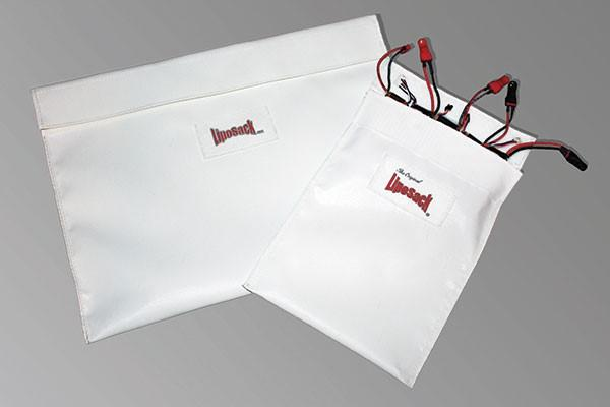
With a second prototype that included a flap at the top of the sack, Mark took them to his friend Steve Belknap who at the time was a leading distributor of battery packs for the electric aircraft community through his company Diversity Model Aircraft. Steve immediately saw the financial opportunity. Steve convinced Mark that it was time to go into business and start selling these bags right away. Mark was the ideas guy, Steve was the businessman, who would be the seamstress? Mark knew a lady named Tracy Gantz who sewed uniforms for local schools and hired her to make as many bags as she could. She produced 50 bags on a Thursday night. Mark and Steve took these the next Friday morning to the Silent Electric Flyers of San Diego (SEFSD) field near Sea World for the large 2006 Midwinter Electrics event that was happening that weekend. Steve offered the bags for sale in his Diversity Model Aircraft booth. By the end of the day all 50 were sold. The next night Tracy worked again to produce 50 bags. These were brought to the field on Saturday morning and by noon all 50 were sold. These bags became the beginning of a new company Woodworks Products which markets the now very popular “LiPo Sack” via www.liposack.com. Knockoff products have been offered internationally but the LiPo Sack continues to be the leader in the field. (Please check out the Survivors Gallery on the above link to really see how well the bag holds up to LiPo fires. The result of this safety device is many garages, cars, and people saved.) Mark continues to sell the LiPo Sack not only to the hobby market but also with alteration to the airline industry that suffers from the same concern about LiPo fires.
In about 2002 Mark also started flying regularly at slope soaring sites in San Diego County, including those operated by the TPG and those not such as Lake Hodges, Dave’s Beach, Horse Canyon and other sites. He flew many, many different aerobatic planes including a stretched-wing CR Contender originally built by Steve Condon (a plane he still owns), a Pike Precision, a foamy Ka-8, etc. Mark’s chief interest was in having fun and not competition. His enjoyment was flying with friends like Mark Canfield or Marty Dine, following each other in the endless lift at Torrey, and having good times. At the end of 2009, Mark volunteered to serve as Slope Coordinator for 2010 at a time when Mark Canfield and Marty Dine also volunteered to help run the TPG. This was at a time when Robin Marien had just begun his service as Concessionaire at the gliderport and relations between the PG/HG and RC weren’t all that great. Mark Wood, Mark Canfield, and Marty Dine helped to turn that around and keep the site secured for RC soaring. Mark wood helped train new pilots, get them set up with Torrey ratings, etc. He was also good friends with Bob Martin and encouraged the organization of the Katie Martin fun fly, an annual tradition that continues to present. One of Mark Wood’s happiest memories at Torrey was the day when Dale Gottdank returned to Torrey after a life-altering illness. Mark handed him the transmitter to a Gentle Lady and enjoyed helping his friend Dale get back in the sky.
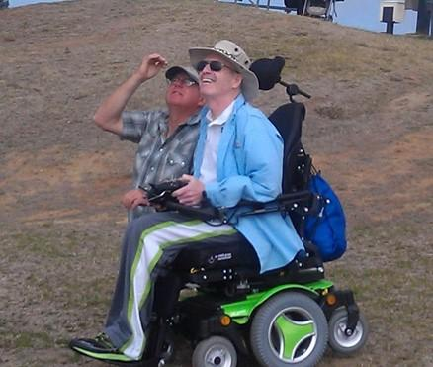
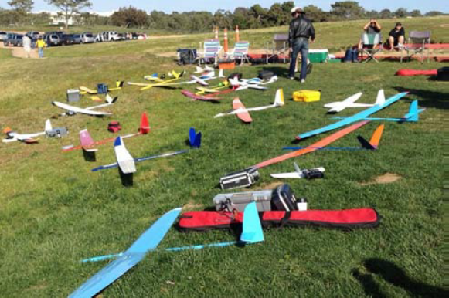
By 2011 Mark retired and moved to Tehachapi. This required that he give up his position as Slope Coordinator to Alvaro Corzo, something he wished he didn’t have to do, but he continued flying RC at slopes in the Tehachapi area, In 2022, he and his wife Becky moved to Pensacola, Florida to be closer to family. There aren’t a lot of hills in Florida but I’m going to bet that Mark will find and fly them soon. Mark’s motto in life is that things happen for a reason – we should be grateful for what we get and if you are grateful then things will keep going. He’s grateful for his time with friends in the TPG and for having been honored with the 2011 Modeler of the Year Award for his service to the club at the slope.