 Welcome to Torrey Pines Gulls
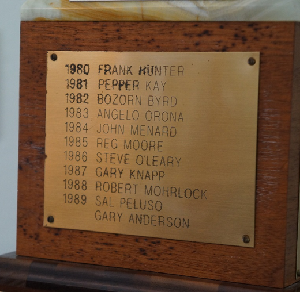
Sal Peluso – Co-Modeler of the Year - 1989
Born in the 1950s, Sal Peluso first started developing an interest in model aviation at age 10. One of his neighbors in Linda Vista, a gentleman named Bob Enslo, was a local modeler who had a passion for gas-powered free flight planes. After dinners at home, Sal would walk down the street and if the light was on in Enslo’s garage, Sal knew it would be OK to enter through a side door and join him (and his cat) in the garage. They would build something. It didn’t matter what, as long as it flew.
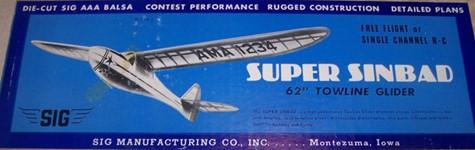
In those days, free flight contests were held at Kearney Mesa right about where Claremont Mesa Drive meets Ruffin Road on what was at the time an empty field west of where Discount Hobby Warehouse is today. Sal would occasionally attend the contests too, and also explored free flight catapult gliders. The local hobby shop in Linda Vista had a nice selection of model kits, mainly Guillows or other types of free flight/rubber band powered designs. These were somewhat inexpensive for a kid, but one year Sal had his eye on a Sinbad glider. It was too expensive: $1.25. That year, Santa provided $5.00 for Christmas and Sal knew just what to do. He bought a Sinbad kit and glue. But he still lacked enough money for tissue paper for the covering. Fortunately, the same shopping mall had a shoe store, and behind the shoe store was a dumpster. The shoe boxes always had tissue paper in them, and Sal gathered up as much free tissue paper as he could find. Glue was also expensive, so much of Sal’s work focused on using white glue and just wetting the tissue paper lightly so that it would shrink in place without warping. He became very proficient at this technique. Enslo’s high school aged son would also sometimes fly u-control models with Sal.
In 1946, Sal’s father had started a local company called San Diego Fireworks. They were the main company in town for 4th of July celebrations and Sal worked for his dad for a time. Sal left aeromodelling for a time to pursue dirt flat track motorcycle racing. He became very adept at this and for a time raced on the Grand National Circuit for professional experts. When not racing or launching fireworks, Sal worked for a welding shop in Pacific Beach. It was a job-shop with many different types of custom fabrications. This hands-on experience taught Sal a lot about design, construction, and engineering, and he later would apply those lessons to airplanes. Sal married at 22 years of age. In 1977 he started his own welding company, Kearney Mesa Welding and one year later in 1978 he stopped racing motor track.
On a rainy day he went back to the hobby store and the trip re-kindled his interest in models. He bought a Frank Zaic Thermic glider and later a Gentle Lady. Not knowing where or how to fly a radio-controlled glider, he started flying on his own near Mission Bay. This resulted in many crashes. One smart onlooker suggested that he should go to Torrey Pines as that’s where most people were flying RC gliders and there would be a club to help him. Sal and Bob Morhlock got into RC at the same time this way and became buddies. Together and through help of many people in the Torrey Pines Gulls, largely Ken Tagami and Joe McBride, they learned aerodynamics by doing.
Upon checking out the scene at Torrey, Sal saw all of the “hi-tech” equipment and larger, sleeker designs. He quickly wanted to get into other aspects of RC soaring. Multiplex was manufacturing larger ¼ scale sailplanes at the time, and Sal thought that the scale ships were beautiful. With encouragement by Carl Gwartney, Larry Fogel, and Angelo Orona, Sal got seriously into scale. Using Carl Gwartney’s workshop at his house in Morena, and with his many years of building techniques, Sal started scratch building models. His first scratch built scale aircraft was a Schweizer TG-2, the same that Carl Gwartney had trained in as a glider pilot in World War II.
In 1980, Sal attained both a private pilot’s license at Montgomery Field and also an amateur radio license which allowed him to fly RC on the less popular 53MHz frequencies and avoid frequency issues with 72MHz at the cliff. This was a common approach for scale enthusiasts, who had a lot of time and money to lose in their larger sailplanes – avoiding a pin-board frequency conflict and crash was paramount. After his father passed unexpectedly, Sal and his family carried on with the family fireworks company, operating shows all over San Diego including sporting events and at Sea World. In 1984 they sold the fireworks company, but Sal continued to help as an operator of shows until 1994 when he helped establish another Peluso-related fireworks company called Fireworks America. Sal helped that company with shows until 2014 and the company still exists.
Sal continued flying RC during these years. He attended thermal duration contests with the Thermal Pilots Association led by John Menard in the south bay or with the Torrey Pines Gulls and friend Bob Anderson at Hourglass Field. With a growing interest and dedication towards scale soaring, Sal Peluso, Angelo Orona, Larry Fogel, and Carl Gwartney formed the Torrey Pines Scale Soaring Society in 1991. Oddly, given Sal’s many hours spent with motor track racing, he never did develop much of an interest in slope racing. However, Sal saw the importance of helping both clubs – the TPG for contests and to help newcomers, and the TPSSS for scale soaring, building, and the unique issues that arise when working with larger models.
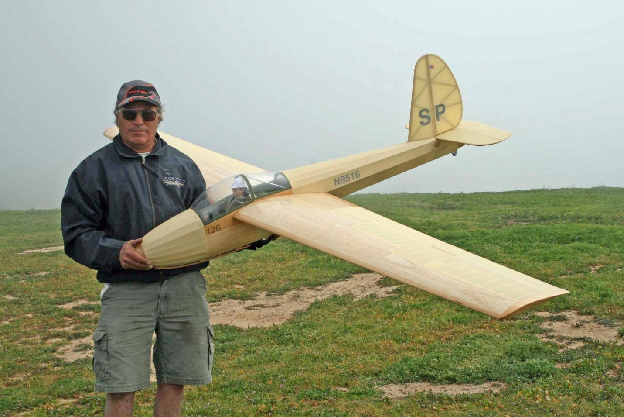
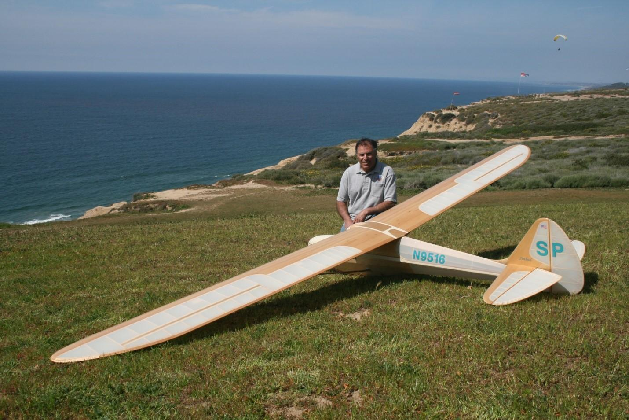
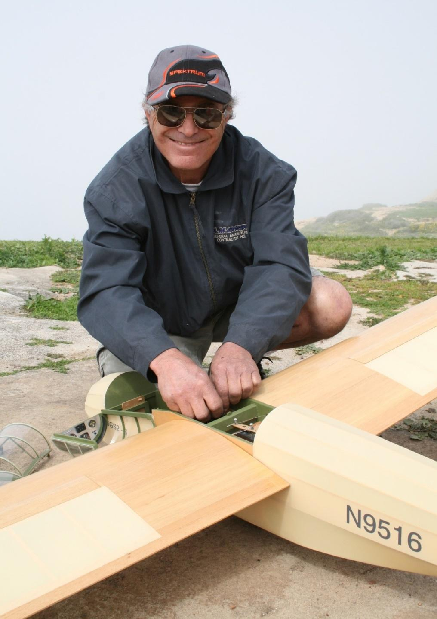
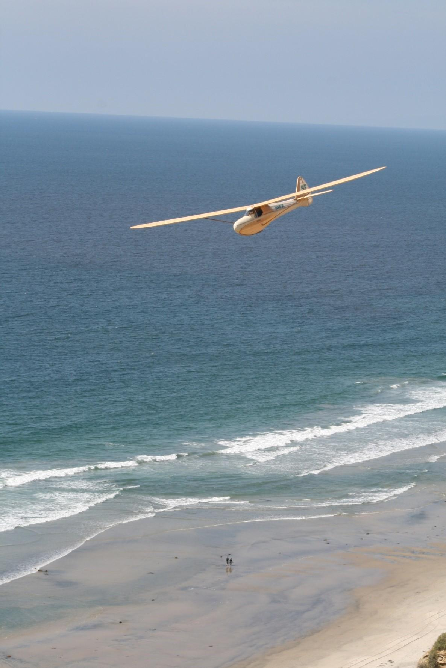
In the 2000s, Sal remembered his Sinbad. It was an interesting design, one that looked like it actually could have been a real glider but never was. Sal set it in mind to scratch build a Sinbad but modify it slightly to make it look even more scale, and size it up by 150%, with a wingspan between what would have been something on the order of 1/4 to 1/3 scale had there actually been a real man-carrying Sinbad glider. He built this model over many months. Selecting specific wood, matching grains on the wings so that they were symmetrical, etc. The result was an immaculate Sinbad that has flown at Torrey several times, a remarkable glider that represents not only Sal’s amazing talent at building but his many years of association with aeromodelling.
In 2004, Sal sold Kearney Mesa Welding, not to retire but simply to have someone else run the company. The TPG have benefited over the years with Sal’s expertise at welding – the current pinboard at Torrey is Sal’s handiwork, as was the one prior to that (and even perhaps the one prior to that).
Sal served as Treasurer for the TPG for several years and helped generate considerable interest in the hobby at Torrey. I had the pleasure of interviewing him for this article and he wanted to say that he is proud that the Torrey Pines Gulls lives on, and continues to provide all of the things it does to help new pilots get into the hobby. He especially wants to thank the club officers for keeping it all going, as he knows how much effort that can be.